
Use this form to assist you to complete risk assessments for hazardous activities and processes. Any serious or ongoing hazards should be reported via RiskWare to ensure that appropriate corrective actions are tracked and completed.
| Identify the activity and the location | Identify who may be at risk This might include fellow workers, students, visitors, contractors, patients, research participants and the public. |
|---|---|
| Activity or process: - General work in optical and laser laboratories - Optical alignment and experimentation - Equipment setup and operation - Laboratory access and conduct - Movement around laboratory spaces - Use of optical benches and equipment - General laboratory housekeeping |
Persons at risk: - Academic staff and researchers - PhD and Masters students - Undergraduate students (supervised) - Visiting researchers - Contractors performing maintenance - Laboratory visitors - Cleaning staff |
| Location: SAIL Laboratory Areas: - Room 116B (temperature-controlled room) - Room 116C (3D printing room) - Room 121A (breakout/meeting room) - Rooms 121B-C (standard optical labs) - Room 121D (fibre fabrication lab) - Room 120 (standard optical lab) - Rooms 218G-H-I (fibre fabrication and optical labs) School of Physics, University of Sydney |
Risk assessment team (who was consulted?): - Chris Betters (Laboratory Supervisor) - Sergio Leon-Saval (Laboratory Supervisor) - Laboratory technical staff - Laboratory users and researchers - School of Physics Safety Officer - Facilities maintenance personnel |
List of Legislation, Code of Practice, Australian Standards, Guidance Materials used to determine control measures
- Work Health and Safety Act 2011
- Work Health and Safety Regulation 2017
- AS/NZS 2243.1:2005 Safety in laboratories - Planning and operational aspects
- AS/NZS 2243.2:2006 Safety in laboratories - Chemical aspects
- AS/NZS 2243.10:2004 Safety in laboratories - Storage of chemicals
- AS/NZS IEC 60825.1:2014 Safety of laser products - Equipment classification and requirements
- AS/NZS 4801:2001 Occupational health and safety management systems
- AS/NZS 1337.1:2010 Eye and face protection - Eye protectors for occupational applications
- University of Sydney WHS policies and procedures
- University of Sydney Laboratory Safety Manual
- School of Physics Local Safety Procedures
- Manufacturer documentation for installed equipment and safety systems
- Building management and emergency procedures
Risk Assessment Methodology
Assessing the risk is a brainstorming exercise, which is most effectively carried out in a team environment with the people required to complete the activity or process. Most activities or processes are broken down into a variety of separate tasks. For each task, consider the hazards, the potential harm or negative outcomes and the conditions required for those negative outcomes to occur.
Whenever assessing the health and safety risks associated with a task, always consider the following primary risk factors:
- The physical activities required to complete the task e.g. repetitive movement, high force, physical exertion, awkward posture
- The work environment e.g. lighting, layout, traffic flow, ventilation, access to support (isolation)
- The nature of the hazard itself e.g. working with chemicals, microorganisms, radiation, use of plant and equipment, sharps, working with potentially aggressive clients, patients or research participants
- The people involved, e.g. level of training, supervision, experience, health, age, physical capacity.
The information gathered from the risk assessment process must be used to develop Safe Work Procedures (SWPs) and local induction programs for laboratory access and activities.
Scope of This Risk Assessment:
This is a foundational risk assessment covering general laboratory safety across all SAIL laboratory areas. It establishes baseline safety requirements and controls that apply to all laboratory users.
Equipment-specific and activity-specific hazards are covered by separate Risk Assessments and Safe Work Procedures, including:
- Individual equipment RAs/SWPs (e.g., Bambu Lab H2D, CMS, Form 3 printers, laser systems)
- Fibre Optics Handling RA/SWP
- Chemical Handling RA/SWP
- Electrical Safety RA/SWP
All laboratory users must comply with both this general RA and any applicable specialist RAs/SWPs for their specific activities.
Hazard Assessment Table
| Task or scenario | Hazard/s | Associated harm, e.g. what could go wrong? | Existing Risk Controls | Current risk rating | Any additional controls required? | Residual risk rating |
|---|---|---|---|---|---|---|
| LABORATORY ACCESS AND GENERAL CONDUCT | ||||||
| Unauthorised or inadequately trained personnel accessing laboratory areas | Unauthorised access, inadequate training | - Exposure to hazards without understanding risks - Incorrect operation of equipment - Inability to respond to emergencies - Injury to self or others - Damage to equipment |
- Swipe card access control - Access only granted after completing SAIL Lab General Local Induction - Authorised entry signage on doors listing risks and PPE requirements - Supervisor approval required for access |
Medium | - Mandatory SAIL Lab General Local Induction before access granted - Maintain authorised users list - Regular review of access permissions - Visitors must be signed in and supervised - Induction records maintained - Annual refresher training for infrequent users |
Low |
| Unsupervised undergraduate students | Inadequate supervision, inexperience | - Exposure to hazards beyond competency level - Incorrect equipment operation - Inability to recognize dangerous situations - Delayed response to emergencies |
- University policy requiring supervision - Laboratory supervisor oversight - Sign-in procedures |
High | - MANDATORY: Undergraduates must be supervised at all times - Supervisor must be physically present in laboratory - Supervisor responsible for ensuring safe practices - Sign-in/sign-out log maintained - Clear supervision protocols documented - Supervisors must be trained and competent |
Low |
| Poor housekeeping and laboratory conduct | Cluttered workspace, equipment left running unattended, food/drink in lab | - Slips, trips, and falls - Fire hazards from clutter - Contamination of experiments - Chemical spills - Equipment damage - Cross-contamination |
- Laboratory rules and guidelines - Regular cleaning schedules - Designated eating areas outside labs |
Medium | - No food or drink in laboratories - Clear desk policy - return equipment to storage - Cable management and trip hazard awareness - Regular housekeeping inspections - Waste disposal procedures followed - Equipment not left running unattended unless specifically approved - Spills cleaned immediately |
Low |
| OPTICAL HAZARDS | ||||||
| Exposure to bright light sources (alignment lasers, LEDs, lamps, broadband sources) | Optical radiation, bright visible light | - Temporary flash blindness - Eye strain and fatigue - Retinal damage from extended exposure - Dazzle affecting ability to see hazards - Headaches and discomfort |
- Warning labels on equipment - Controlled access to powered equipment - General laboratory lighting |
Medium | - Never look directly into beam or light source - Use beam blocks and shutters when not actively aligning - Use viewing cards or cameras for beam visualization - Appropriate safety glasses/goggles when required - Limit exposure duration during alignment - Work at lowest intensity possible - Turn off sources when not in use |
Low |
| Specular reflections from optical surfaces (mirrors, lenses, beam splitters, polished metal) | Unexpected reflected beams, multiple reflection paths | - Eye injury from reflected beams - Exposure to beams from unexpected directions - Difficulty tracking all beam paths - Reflections at eye level |
- Optical benches at comfortable working height - Standard laboratory practices - User training in optical safety |
Medium | - Remove reflective items (watches, jewellery, lanyards) before optical work - Be aware of all potential reflection surfaces - Use anodised or black optical mounts to minimize stray reflections - Position yourself to avoid reflected beam paths - Use beam dumps for unwanted beams - Never wear reflective clothing near active optical setups - Mark beam paths clearly - Work at sitting height when possible to keep beams below eye level |
Low |
| Stray or scattered light in darkened laboratory environments | Reduced visibility, dark-adapted eyes more sensitive | - Trips and falls in darkness - Collisions with equipment - Increased sensitivity to stray light exposure - Inability to see hazards - Difficulty reading safety labels |
- Emergency lighting systems - Ambient light available when needed |
Medium | - Maintain adequate lighting for safe movement - Use red lighting for dark-adapted work (less disruptive) - Allow time for eyes to adjust when entering/leaving dark areas - Use torches/headlamps when needed - Keep walkways clear and well-defined - Ensure emergency exits remain visible - Never work alone in darkened laboratories |
Low |
| LASER HAZARDS (GENERAL - Equipment-specific lasers have dedicated RAs) | ||||||
| Exposure to laser radiation from alignment lasers and laser systems | Direct beam exposure, specular reflections | - Retinal damage or burns (Class 3B, 4) - Permanent vision loss - Skin burns (Class 4) - Fire ignition (Class 4) - Temporary flash blindness (Class 2, 3R) |
- Equipment-specific laser RAs and SWPs - Laser warning signage on doors - Some laboratories have interlock systems - Classification labels on laser equipment |
High | - MANDATORY: Laser Operator Certificate required for all personnel working with or near lasers - Comply with equipment-specific laser RA/SWP - Appropriate laser safety eyewear for wavelength and class - Never look into beam or at specular reflections - Use lowest power necessary during alignment - Beam path at or below sitting height where possible - Laser safety eyewear worn during operation of Class 3B/4 lasers - Respect laser interlock systems - never bypass - Room signage indicates laser in use - Curtains or barriers to prevent exposure to adjacent areas |
Low |
| Laser interlocks bypassed or defeated | Exposure to laser radiation without safety systems active | - Unexpected laser exposure during room entry - Exposure to Class 3B/4 radiation - Multiple personnel exposed - Severe eye or skin injury |
- Interlock systems on some laboratory doors - Warning signage - Laboratory procedures prohibiting bypass |
Very High | - NEVER bypass or defeat laser interlocks - Interlocks must be functional before laser operation - Report faulty interlocks immediately - Do not operate lasers if interlocks not working - Disciplinary action for intentional bypass - Regular testing of interlock systems - Alternative controls if interlock maintenance required (laser lockout) |
Low |
| ROOM-SPECIFIC HAZARDS | ||||||
| Working in Room 116B (temperature-controlled with CO2 risk) | Elevated carbon dioxide levels, oxygen displacement | - Asphyxiation - Headaches and dizziness - Confusion and impaired judgment - Loss of consciousness - Hypercapnia (CO2 poisoning) - Death in extreme cases |
- CO2 sensor and monitoring system installed - Automatic fresh air introduction when elevated CO2 detected - Alarm system for high CO2 levels - Temperature control via air recirculation system |
High | - NEVER work in Room 116B with door closed - Door must remain open during occupancy - If door must be closed (temperature control), personnel must leave room - Monitor CO2 alarm system - evacuate if alarm sounds - Limit time in room when door closed (access only to check equipment) - Buddy system recommended for work in 116B - Understand symptoms of CO2 exposure - Report any alarm activations or sensor faults immediately - Regular sensor calibration and maintenance - Warning signage on door regarding CO2 risk and door policy |
Low |
| Work in fibre fabrication labs (121D, 218G) | Sharps hazards from cleaved fibre ends | - Puncture wounds to hands, fingers, eyes - Fibre fragments embedded in skin - Infection from contaminated sharps - Eye injury from fibre fragments |
- Dedicated fibre fabrication areas - Portable eyewash stations in fibre labs - Fibre disposal containers |
Medium | - Follow Fibre Optics Handling RA/SWP (dedicated document) - Appropriate sharps containers for fibre waste - Never handle fibre ends carelessly - Dispose of cleaved fibres immediately - Safety glasses mandatory during fibre cleaving - Inspect hands and work area for fibre fragments - First aid procedures for fibre injuries - Portable eyewash readily accessible |
Low |
| Work in 3D printing room (116C) | Specific to 3D printers (fumes, thermal, mechanical) | - See individual equipment RAs | - Bambu Lab H2D RA/SWP (SAIL-RA-BAMBU-H2D-001) - Form 3 printer RAs/SWPs - Dedicated 3D printing room with ventilation |
Varies | - Follow equipment-specific RA/SWP for each printer - Room ventilation adequate for printing operations - Equipment-specific training required |
Low |
| MECHANICAL HAZARDS | ||||||
| Manual handling of heavy optics, equipment, optical tables | Heavy items, awkward shapes, precision equipment | - Back strain and musculoskeletal injuries - Crushed fingers or toes - Dropped equipment causing damage - Foot injuries from falling objects - Hernias from improper lifting |
- Mechanical lifting aids available - Trolleys and carts in some areas - Standard laboratory furniture height |
Medium | - Use mechanical aids (trolleys, hoists) for heavy items (>15 kg) - Two-person lift for awkward or heavy items - Proper lifting technique (bend knees, straight back, load close to body) - Closed-toe shoes mandatory in all laboratories - Plan lift route before moving items - Ask for assistance when needed - Steel-toe boots recommended for moving heavy optical tables or equipment - Clear pathway before moving heavy items - Use appropriate PPE (gloves for grip, not for heavy lifting) |
Low |
| Moving parts on optical stages, translation mounts, rotation mounts | Motorized stages, manual adjustment screws, rotating components | - Pinch points crushing fingers - Entanglement with rotating parts - Impact injuries from unexpected motion - Equipment damage from collisions |
- Emergency stops on motorized equipment - Guards on some equipment - Standard operating procedures |
Low | - Keep hands clear of moving parts during operation - Emergency stop accessible and known - Be aware of motorized stage motion before activation - Remove loose clothing, jewellery, lanyards before working near moving parts - Tie back long hair - Equipment-specific training for motorized systems - Stop motion before adjusting or clearing obstacles - Appropriate speed settings for manual operation |
Very Low |
| Sharp edges on optical mounts, equipment housings, metal components | Machined metal parts, mounting hardware, corners | - Cuts and lacerations to hands - Torn gloves or clothing - Bleeding - Infection if not treated |
- Standard laboratory equipment design - First aid kit available on level |
Low | - Handle optical components and mounts carefully - Inspect equipment for sharp edges or burrs - Wear appropriate gloves when handling rough metal parts (not during optical alignment) - Deburr sharp edges where possible - First aid available for minor cuts - Wash cuts immediately and apply dressing |
Very Low |
| SLIPS, TRIPS, AND FALLS | ||||||
| Trailing cables, equipment on floor, cluttered walkways | Power cables, fibre optic cables, equipment placement | - Trips and falls causing injury - Sprains and fractures - Head injuries from falling onto equipment - Pulled muscles - Equipment damage from falls |
- Generally organized laboratory spaces - Optical benches and tables for equipment storage |
Medium | - Cable management: secure cables along walls or overhead - Use cable protectors where cables cross walkways - Keep walkways and exits clear at all times - Store equipment on benches, not on floor - Return unused equipment to storage areas - Report trip hazards immediately - Good housekeeping practices - Adequate lighting in all work areas - Mark permanent cable routes with tape or warning signs |
Low |
| Spills of liquids (water, solvents, optical fluids) | Wet floors, slippery surfaces | - Slips and falls - Impact injuries - Chemical exposure from spill contact - Spread of contamination |
- Spill response procedures - Cleaning materials available - Chemical handling RA/SWP |
Medium | - Clean up spills immediately - Use “wet floor” warning signs if needed - Appropriate spill cleanup materials for chemical spills - Follow Chemical Handling RA/SWP for chemical spills - Report large or hazardous spills to supervisor - Wear appropriate PPE during cleanup - Dispose of contaminated materials correctly - Dry floor thoroughly after water spills |
Low |
| ELECTRICAL HAZARDS (GENERAL - Specific equipment has dedicated RAs) | ||||||
| Contact with 240V mains electricity from equipment, power supplies, extension cords | Exposed conductors, damaged cords, wet conditions | - Electric shock - Electrocution - Burns from arc flash - Cardiac arrest - Secondary injuries from falls |
- RCD protection on building circuits - Earthed equipment and power points - Electrical safety standards compliance - Test and tag program |
Medium | - Visual inspection of cords and equipment before use - Report damaged cords or equipment immediately - Never use electrical equipment in wet conditions - Do not overload power points or extension cords - Qualified electrician for all repairs - Follow Electrical Safety RA/SWP for specific procedures - Equipment test and tag current - Switch off and unplug equipment before internal access (if qualified) - Emergency switch-off locations known |
Low |
| CHEMICAL HAZARDS (GENERAL - Specific chemicals have dedicated procedures) | ||||||
| Use of solvents, adhesives, cleaning agents (isopropanol, acetone, optical adhesives) | Chemical exposure, vapour inhalation, skin contact | - Skin irritation and dermatitis - Eye irritation or damage - Inhalation of vapours causing respiratory irritation - Fire hazard from flammable solvents - Allergic reactions |
- Chemical handling procedures - SDS available - General laboratory ventilation - Designated chemical storage areas |
Medium | - Follow Chemical Handling RA/SWP (dedicated document) - Consult SDS before use - Appropriate PPE (gloves, safety glasses, lab coat) - Use in well-ventilated areas or fume cupboard - Store chemicals correctly (flammables cabinet, segregation) - Minimize quantities in use - Label all containers clearly - No naked flames near flammable solvents - Spill kit available and users trained - Wash hands after chemical handling - Portable eyewash in fibre labs |
Low |
| ENVIRONMENTAL AND ERGONOMIC HAZARDS | ||||||
| Prolonged sitting or standing during optical alignment | Static postures, repetitive fine movements | - Musculoskeletal discomfort - Back and neck pain - Eye strain - Fatigue and reduced concentration - Repetitive strain injuries |
- Adjustable chairs available - Workbenches at appropriate height - General laboratory ergonomics |
Low | - Take regular breaks during long alignment sessions - Alternate between sitting and standing - Adjust chair and bench height for comfort - Stretch and move periodically - Rest eyes by looking at distant objects - Report persistent discomfort to supervisor - Ergonomic assessment available if needed |
Very Low |
| Inadequate lighting for detailed optical work | Poor illumination, glare, shadows | - Eye strain and headaches - Reduced accuracy in alignment - Increased error rate - Difficulty seeing hazards - Fatigue |
- Building lighting systems - Task lighting available in some areas |
Low | - Use task lighting for detailed work - Adjust lighting to suit task (bright for assembly, dim for beam visualization) - Report faulty lighting immediately - Position work to avoid glare and shadows - Take eye rest breaks during prolonged detailed work |
Very Low |
| Working alone in laboratory areas | Isolation, delayed emergency response | - Delayed discovery if injured - Delayed emergency response - No assistance available - Psychological stress |
- Building security and access controls - Emergency call points - After-hours security patrols |
Medium | - Buddy system encouraged, especially for higher-risk work - Inform supervisor or colleague when working after hours - Mobile phone accessible for emergency calls - Know location of emergency call points - Avoid high-risk activities when alone (e.g., working at height, Class 4 lasers) - Regular check-in procedures for extended solo work - Never work alone if feeling unwell |
Low |
| FIRE HAZARDS | ||||||
| Fire from electrical faults, flammable chemicals, laser ignition | Electrical equipment, solvents, laser sources | - Burns and smoke inhalation - Building damage - Entrapment if exits blocked - Toxic fumes from burning materials - Loss of research equipment |
- Fire detection systems - Fire extinguishers in various areas - Emergency exits marked - Building evacuation procedures |
Medium | - Know location of nearest fire extinguisher and type - Know emergency exit routes and assembly points - Do not block exits or extinguishers - Turn off equipment when not in use - Store flammable chemicals correctly (quantities limited, flammables cabinet) - Regular fire drills and training - Report fire hazards immediately - If fire: evacuate, activate alarm, call 000 - Only fight small fires if safe to do so - Follow building fire warden instructions |
Low |
Implementation of Additional Risk Controls
| Additional controls needed | Resources required | Responsible person | Date of implementation | RiskWare Reference |
|---|---|---|---|---|
| Develop and deliver SAIL Lab General Local Induction | Time (4-6 hours for development), training materials, presentation facilities | Chris Betters / Sergio Leon-Saval | Prior to granting laboratory access to new users | N/A |
| Implement and maintain authorised users list for swipe card access | Access control system, database maintenance | Laboratory Manager / Supervisors | Ongoing - updated as personnel join/leave | N/A |
| Establish sign-in/sign-out log for undergraduate supervision tracking | Log book or electronic system | Laboratory Supervisor | Prior to undergraduate access | N/A |
| Update and maintain door signage for all laboratory areas (hazards, PPE, authorised entry) | Signage materials, laminating, mounting hardware | Facilities / Laboratory Manager | Prior to use - update as hazards change | N/A |
| Ensure Laser Operator Certificate training available and records maintained | External training provider or internal certified trainer, training records system | Chris Betters / Sergio Leon-Saval | Prior to any laser work | N/A |
| Install/verify CO2 sensor and alarm system in Room 116B, establish monitoring and calibration schedule | CO2 sensor, alarm system, calibration equipment, qualified technician | Facilities / Building Manager | Already installed - verify operational quarterly | TBD |
| Procure and install portable eyewash stations for fibre fabrication labs (121D, 218G) | Portable eyewash units, mounting brackets, regular water replacement | Laboratory Manager | Already installed - monthly inspection required | N/A |
| Establish equipment test and tag schedule for electrical safety | Qualified testing technician, testing equipment, record keeping | Facilities / Laboratory Technician | Ongoing - annual testing cycle | TBD |
| Procure cable management solutions (cable protectors, overhead routing, wall clips) | Cable management hardware, installation time | Laboratory Technician / Users | Ongoing - as new equipment installed | N/A |
| Develop and implement Chemical Handling RA/SWP | Time (4 hours), chemical inventory, SDS collection | Laboratory Manager / Safety Officer | Within 3 months | N/A |
| Develop and implement Electrical Safety RA/SWP | Time (4 hours), electrical equipment inventory | Laboratory Manager / Safety Officer | Within 3 months | N/A |
| Develop and implement Fibre Optics Handling RA/SWP | Time (4 hours), sharps procedures, equipment inventory | Laboratory Manager / Fibre specialists | Within 3 months | N/A |
| Install additional task lighting in laboratories where needed | Task lamps, LED lighting, installation | Facilities / Laboratory Manager | As required - user request | TBD |
| Establish buddy system protocols and lone worker check-in procedures | Communication protocols, sign-in system | Laboratory Supervisors | Within 1 month | N/A |
| Regular housekeeping inspections and feedback to users | Time for monthly inspections, checklist | Laboratory Supervisor / Safety Officer | Monthly from implementation | N/A |
| Annual refresher training for infrequent laboratory users | Training materials, scheduling | Chris Betters / Sergio Leon-Saval | Annually for users accessing <4 times per year | N/A |
| Verify fire extinguisher locations, types, and inspection currency | Fire safety audit, extinguisher servicing | Facilities / Fire Warden | Quarterly inspection | TBD |
| First aid kit inspection and restocking schedule | First aid supplies, inspection checklist | Laboratory First Aider / Safety Officer | Monthly inspection | N/A |
List emergency controls
These might include how to deal with fires, spills, emergency shutdown of equipment, exposure to hazardous materials and adverse reactions or the deteriorating condition of patients/research participants in our care.
CRITICAL: General Laboratory Safety
- NEVER work in Room 116B with the door closed - CO2 asphyxiation risk
- NEVER bypass or defeat laser safety interlocks - severe eye injury risk
- NEVER allow unsupervised undergraduate students - mandatory supervision at all times
- NEVER look directly into any beam or bright light source - eye damage risk
- NEVER work alone when conducting high-risk activities (Class 4 lasers, working at height, handling hazardous chemicals)
- All laboratory work must comply with both this general RA and applicable equipment-specific RAs/SWPs
- If any safety system fails or unsafe condition arises, stop work immediately and report to supervisor
Emergency Evacuation - Building Fire Alarm:
- Immediately upon hearing fire alarm:
- Stop all work immediately
- Leave equipment as is (unless you caused fire and can safely shut down)
- Do NOT collect belongings or shut down computers
- Close doors behind you (do not lock)
- Proceed to nearest emergency exit
- Evacuation route:
- Use marked emergency exits (never use lifts)
- Follow exit signs to assembly point
- Assist others if needed but do not put yourself at risk
- If route blocked, use alternative exit
- Assembly point:
- Proceed to designated assembly point (as marked in building)
- Report to fire warden
- Account for all persons under your supervision
- Do NOT re-enter building until cleared by emergency services or fire warden
- If you discover a fire:
- Activate nearest fire alarm (break glass)
- Call 000 (Emergency Services)
- Evacuate area
- Only fight small fires if safe to do so and you are trained
Fire Emergency (Small, Contained Fire):
- Assess the situation:
- Is fire small and contained (e.g., waste bin, small electrical fire)?
- Is appropriate extinguisher available and accessible?
- Are you trained in fire extinguisher use?
- Is there a clear escape route?
- If safe to fight fire:
- Alert others in area
- Locate appropriate fire extinguisher:
- Dry powder (ABE): General purpose, most fires
- CO2: Electrical fires, will not damage electronics
- Water: Paper, wood (NEVER use on electrical or chemical fires)
- Check pressure gauge is in green zone
- Pull pin, aim at base of flames, squeeze handle, sweep side to side
- Use short bursts
- If fire does not extinguish immediately: EVACUATE
- If fire spreads or intensifies:
- Evacuate immediately
- Close doors behind you (do not lock)
- Activate building fire alarm
- Call 000
- Proceed to assembly point
Room 116B CO2 Emergency:
- If CO2 alarm sounds in Room 116B:
- Evacuate room immediately
- Close door behind you
- Do NOT re-enter to retrieve items
- Notify supervisor and building manager immediately
- Restrict access to room until alarm clears
- If person shows symptoms of CO2 exposure (headache, dizziness, confusion, rapid breathing, loss of consciousness):
- Remove person from room immediately if safe to do so
- If person unconscious: call 000 immediately, begin first aid if trained
- Move to fresh air area
- Loosen tight clothing
- Keep person calm and still
- Monitor breathing and consciousness
- Seek medical attention for moderate to severe symptoms
- Report incident to supervisor
- After alarm clears:
- Do NOT enter until CO2 levels confirmed normal
- Supervisor or building manager must verify system operational
- Investigate cause of alarm (door closed, sensor malfunction, ventilation failure)
- Report incident via RiskWare
Chemical Spill:
- Assess the spill:
- What chemical? (check label or SDS)
- How much spilled?
- Is it spreading?
- Any injured persons?
- Any fire or vapour hazard?
- Small spill (< 500 mL, non-hazardous):
- Alert others in area
- Ventilate area if safe to do so
- Don appropriate PPE (gloves, safety glasses, lab coat)
- Use spill kit to absorb and contain
- Dispose of contaminated materials as hazardous waste
- Clean area thoroughly
- Report to supervisor
- Large spill or hazardous chemical:
- Evacuate area immediately
- Close doors to contain vapours (do not lock)
- Alert supervisor immediately
- Call University Security: [insert number]
- Provide SDS if available
- Do NOT attempt cleanup unless trained and equipped
- Restrict access to area
- Follow supervisor instructions
- Chemical contact with skin or eyes:
- See “Chemical Exposure” section below
Chemical Exposure:
Eye contact:
- Immediately flush eyes with water for 15-20 minutes
- Use portable eyewash station (fibre labs) or emergency eyewash
- Hold eyelids open during flushing
- Remove contact lenses if possible
- Continue flushing while someone calls 000 or arranges transport to hospital
- Bring SDS to medical facility
Skin contact:
- Remove contaminated clothing immediately
- Flush affected area with water for 15-20 minutes
- Use safety shower for large area contamination
- Do NOT apply creams or ointments
- Seek medical attention for large areas, persistent pain, or corrosive chemicals
- Report to supervisor and complete incident report
Inhalation:
- Move person to fresh air immediately
- Loosen tight clothing
- Keep person calm and still
- If breathing difficulty: call 000 immediately
- If person stops breathing and you are trained: begin CPR
- Provide SDS to emergency services
- Seek medical attention for significant exposure
Ingestion:
- Call 000 or Poisons Information Centre: 13 11 26 immediately
- Do NOT induce vomiting unless directed by medical professional
- Rinse mouth with water (do not swallow)
- Provide SDS to emergency services
- Keep person calm and monitor until help arrives
Electrical Shock:
- If person in contact with electrical source:
- DO NOT TOUCH the person - you may be shocked
- Turn off power at source if safe to do so (switch, circuit breaker)
- If cannot turn off: use non-conductive object (dry wood, plastic) to separate person from source
- Call 000 immediately
- Once person separated from electricity:
- Check responsiveness and breathing
- If unconscious but breathing: place in recovery position
- If not breathing and you are trained: begin CPR immediately
- Continue CPR until help arrives or person recovers
- Treat any burns (see below)
- Keep person still and warm
- Monitor until emergency services arrive
- For minor shock (tingling, no loss of consciousness):
- Sit person down and keep calm
- Monitor for delayed symptoms
- Seek medical evaluation (electrical injury can have delayed effects)
- Report incident to supervisor
- Equipment isolation:
- Tag equipment as defective
- Lock out equipment to prevent further use
- Report to supervisor and facilities immediately
- Do NOT use equipment until inspected and repaired by qualified electrician
Burns (Thermal):
- For thermal burns from hot surfaces or equipment:
- Remove from heat source immediately
- Cool affected area with running cool (not ice-cold) water for 20 minutes
- Remove jewellery or tight clothing near burn (unless stuck to skin)
- Cover burn with clean, non-fluffy material (cling film ideal)
- Do NOT apply creams, ointments, ice, or butter
- Do NOT burst blisters
- Seek immediate medical attention if:
- Burn larger than 20p coin (≥5 cm diameter)
- Burn on face, hands, feet, joints, or genitals
- Full thickness burn (white or charred skin)
- Blistering over large area
- Victim is child or elderly
- Chemical or electrical burn
- Unsure of severity
- For minor burns:
- Continue cooling for 20 minutes
- Cover with sterile dressing
- Take over-the-counter pain relief if needed
- Monitor for signs of infection (increased pain, redness, swelling, pus)
- Complete first aid documentation and incident report
Laser Eye Exposure (Suspected):
- If suspected laser eye exposure:
- Stop laser operation immediately
- Move person away from laser area
- Do NOT rub eyes
- Record details: laser wavelength, class, estimated exposure duration, beam power
- Seek immediate medical attention (even if no immediate pain - retinal damage may not be immediately apparent)
- Call supervisor immediately
- For Class 3B or 4 lasers: go to hospital emergency department
- Provide laser safety information to medical staff
- Even if no immediate symptoms:
- Arrange ophthalmological examination within 24 hours
- Document incident in detail
- Complete RiskWare incident report
- Notify Laser Safety Officer (if appointed)
- Review incident and implement corrective actions
Injury Requiring First Aid:
- For any injury requiring first aid:
- Assess the situation and ensure area is safe
- Call for first aider or trained personnel
- First aid kit located on level near parents room (outside laboratories)
- For serious injuries: call 000 immediately
- Provide comfort and reassurance to injured person
- Do NOT move injured person unless necessary for safety
- After first aid treatment:
- Complete first aid documentation
- Report to supervisor immediately
- Complete incident report via RiskWare
- For any injury requiring medical treatment: accompany person to hospital or arrange transport
- Notify next of kin if serious injury
Equipment Malfunction or Failure:
- If equipment malfunctions or safety system fails:
- Stop operation immediately
- Press emergency stop if available
- Isolate power if safe to do so
- Do NOT attempt to fix or restart
- Tag equipment as defective (lockout/tagout)
- Restrict access to equipment
- Report to supervisor immediately
- Complete incident report if safety-related
- Arrange qualified technician inspection
- Equipment must NOT be used until all safety systems verified functional and supervisor approves
Emergency Contacts:
- Emergency Services (Fire, Ambulance, Police): 000
- Poisons Information Centre: 13 11 26
- University Security (after hours/weekends): [Insert number]
- Chris Betters (Supervisor): [Insert number]
- Sergio Leon-Saval (Supervisor): [Insert number]
- School of Physics Safety Officer: [Insert number]
- Building Fire Warden: [Insert name and number]
- First Aid Officers: [Insert names and contact details]
- Campus Security Emergency: [Insert number]
First Aid Kit Location: Same level as laboratories, near parents room (outside laboratory areas)
Portable Eyewash Stations: Rooms 121D and 218G (fibre fabrication labs)
Fire Extinguisher Locations: Various locations throughout laboratory areas - know the location nearest to your work area
REVIEW
| 1 year | 2 years | 3 years | |
|---|---|---|---|
| Scheduled review date | February 2027 | February 2028 | February 2029 |
| Are control measures in place (YES/NO) | |||
| Are controls eliminating or minimising the risk (YES/NO) | |||
| Are there any new problems with the risk (YES/NO) | |||
| Reviewed by: | |||
| Actual Review date: |
Risk Matrix
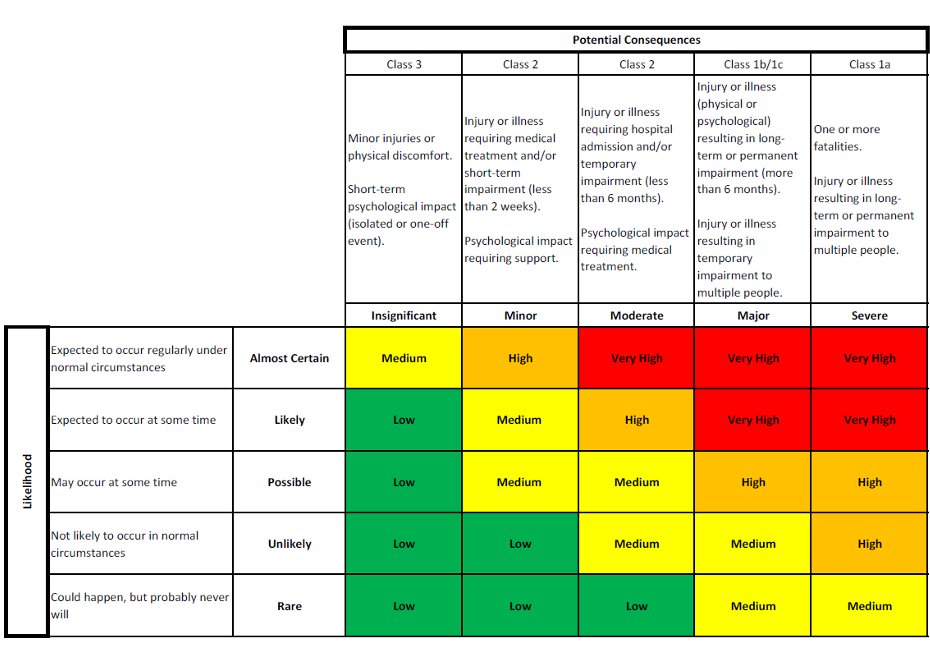
The risk matrix defines:
- Likelihood levels: Rare, Unlikely, Possible, Likely, Almost Certain
- Consequence levels: Insignificant, Minor, Moderate, Major, Severe
- Risk ratings: Low, Medium, High, Very High
End of Risk Assessment
Related Documents
- Fibre Optics Handling RA/SWP - Specialist procedures for fibre cleaving and handling sharps
- Chemical Handling RA/SWP - Procedures for solvents, adhesives, and cleaning agents
- Electrical Safety RA/SWP - Procedures for electrical equipment and high voltage systems
Document Control
| Version | Date | Author | Changes |
|---|---|---|---|
| 1.0 | February 2026 | Chris Betters | Initial release |