

Use this form to assist you to complete risk assessments for hazardous activities and processes. Any serious or ongoing hazards should be reported via RiskWare to ensure that appropriate corrective actions are tracked and completed.
| Identify the activity and the location | Identify who may be at risk This might include fellow workers, students, visitors, contractors, patients, research participants and the public. |
|---|---|
| Activity or process: - Entering and occupying the temperature controlled room - Extended work on optical and instrument hardware within the room - Brief access to check, start or stop equipment - Adjustment and monitoring of experiments requiring a thermally stable environment - Response to CO2, ventilation or flood alarms This document supersedes RA-SWP-A28-116B (initial issue 16/06/2016, current issue 26/04/2020). Research area: Sydney Astrophotonic Instrumentation Labs (SAIL). |
Persons at risk: - Laboratory staff - Research students - Technicians - Visitors to the laboratory - Facilities and maintenance personnel - Cleaning staff |
| Location: Room 116B, Building A28, School of Physics, University of Sydney |
Risk assessment team (who was consulted?): - Sergio Leon-Saval - Barnaby Norris - Julia Bryant - Chris Betters |
List of Legislation, Code of Practice, Australian Standards, Guidance Materials used to determine control measures
- Work Health and Safety Act 2011 (NSW)
- Work Health and Safety Regulation 2017 (NSW)
- Safe Work Australia, Workplace Exposure Standards for Airborne Contaminants (2024) - carbon dioxide TWA 5,000 ppm (8-hour), STEL 30,000 ppm (15-minute)
- Safe Work Australia, Confined Spaces Code of Practice (2020) - referenced as guidance only. Room 116B is a normally occupied workroom with a personnel door and is NOT a confined space under WHS Regulation 2017 Part 4.3. The code is cited only for its guidance on atmospheric monitoring and rescue planning, because the room shares the sealed, recirculating atmosphere characteristic that drives the CO2 hazard.
- AS 1668.2-2012 The use of ventilation and airconditioning in buildings, Part 2: Mechanical ventilation in buildings
- AS/NZS 3000:2018 Electrical installations (Wiring Rules)
- AS/NZS 3760:2022 In-service safety inspection and testing of electrical equipment
- Safe Work Australia, Managing the Work Environment and Facilities Code of Practice (2018)
- University of Sydney WHS policies and procedures, including working alone and after-hours guidance
- SAIL General Optical and Laser Laboratory Safety risk assessment (general-lab-safety), which also covers Room 116B
- Superseded document RA-SWP-A28-116B (26/04/2020)
Risk Assessment Methodology
Assessing the risk is a brainstorming exercise, which is most effectively carried out in a team environment with the people required to complete the activity or process. Most activities or processes are broken down into a variety of separate tasks. For each task, consider the hazards, the potential harm or negative outcomes and the conditions required for those negative outcomes to occur.
Whenever assessing the health and safety risks associated with a task, always consider the following primary risk factors:
- The physical activities required to complete the task e.g. repetitive movement, high force, physical exertion, awkward posture
- The work environment e.g. lighting, layout, traffic flow, ventilation, access to support (isolation)
- The nature of the hazard itself e.g. working with chemicals, microorganisms, radiation, use of plant and equipment, sharps, working with potentially aggressive clients, patients or research participants
- The people involved, e.g. level of training, supervision, experience, health, age, physical capacity.
The information gathered from the risk assessment process must be used to develop a Safe Work Procedure (SWP) or clinical protocol for the activity.
Hazard Assessment Table
| Task or scenario | Hazard/s | Associated harm, e.g. what could go wrong? | Existing Risk Controls | Current risk rating | Any additional controls required? | Residual risk rating |
|---|---|---|---|---|---|---|
| Extended work in the room with the door closed | Excess carbon dioxide levels | The room is sealed with recirculating air conditioning. Extended time in the room causes a slow build up of exhaled CO2, leading to: - Headaches and dizziness - Drowsiness and impaired judgement - Rapid breathing and confusion - Loss of consciousness - Asphyxiation in the extreme case |
Engineering: CO2 monitor installed, triggers fresh air intake when levels increase. Engineering: Red mushroom panic button installed in the room to sound an alarm. Engineering: Temperature control by air recirculation. Administrative: General SAIL induction and specific 116B induction. |
Medium | - Main door MUST remain open whenever the room is occupied. This is the primary control. - If the door must be closed for thermal stability, personnel MUST leave the room. - Door-closed access limited to brief equipment checks only. - Evacuate immediately if the CO2 alarm sounds. Do NOT investigate first. - Warning signage on the door stating the door open rule and the CO2 risk. - Induction to cover the symptoms of CO2 exposure. - Scheduled CO2 sensor calibration and fresh air intake function test. |
Low |
| CO2 monitor, alarm or fresh air intake fails while the room is occupied | Failure of the primary atmospheric control; undetected CO2 accumulation | - No warning of rising CO2 - Occupant becomes drowsy or unconscious without warning - Delayed detection of a hazardous atmosphere |
Engineering: CO2 monitor with automatic fresh air introduction. Engineering: Panic button independent of the CO2 system. Administrative: Building maintenance of HVAC plant. |
Medium | - The door open rule provides passive protection independent of the monitor. - Periodic verification that the sensor and fresh air intake actually operate (function test, NOT a power-on check). - Sensor calibration to the manufacturer schedule. - Any alarm activation, fault or sensor error reported to the supervisor and building manager, and logged. - The room MUST NOT be occupied for extended work while the CO2 system is known faulty or under maintenance. Residual risk remains Medium rather than Low: incapacitation in a sealed room retains a Major consequence even at Rare likelihood, because the failure removes the warning the occupant relies on. |
Medium |
| Working alone in the room, particularly after hours | Isolation within a sealed room; delayed discovery if incapacitated | - Delayed emergency response if the occupant collapses - No assistance available - Consequences of any other incident (CO2, electric shock, injury) worsened by delay |
Engineering: Red mushroom panic button installed in the room. Administrative: Notification of supervisor or appropriate person that work is occurring in the lab. Administrative: Building security and access controls, after-hours security patrols. |
Medium | - Door to remain open, maintaining line of sight and audibility to the corridor. - Confirm the panic button is functional and reachable from the work position before starting. - Mobile phone carried and accessible. - Buddy system or agreed check-in schedule for extended or after-hours work. - Do NOT work alone in the room if feeling unwell. - Panic button included in scheduled function testing. Residual risk remains Medium rather than Low: a lone occupant who is incapacitated retains a Major consequence even at Rare likelihood, since the controls shorten the delay rather than remove it. |
Medium |
| Door closed or latched while a person is inside | Loss of the primary CO2 control; potential entrapment | - Rapid loss of the door open protection - CO2 accumulation with an occupant present - Occupant unable to summon help if also incapacitated |
Engineering: Panic button installed in the room. Engineering: CO2 monitor and automatic fresh air intake. Engineering: Door openable from the inside. |
High | - Signage on BOTH faces of the door: do not close while occupied. - Physical door retention (hold-open device or wedge) while the room is occupied. - Others MUST check the room is unoccupied before closing the door. - Induction to cover the door rule explicitly. - Verify the door can be opened from the inside as part of periodic checks. Residual risk remains Medium rather than Low: the consequence of an occupant sealed in the room stays Major even once likelihood is reduced to Rare. |
Medium |
| Flood water on the laboratory floor | Electric shock | Flood water from a failed drainage system could lead to electrical systems coming into contact with water: - Electric shock - Electrocution - Burns - Slips and falls on wet flooring - Damage to equipment |
Engineering: Socket outlets protected by RCD. Engineering: Socket outlets mounted above floor level. Engineering: Building electrical installation to AS/NZS 3000. |
Medium | - Flood emergency procedure including evacuation of affected areas. - Do NOT enter the room if standing water is present. Isolate power at the distribution board first. - Report water ingress or drainage faults immediately. - Keep floor-standing equipment, leads and power boards clear of the floor where practicable. - RCD testing and equipment test and tag current. |
Low |
Implementation of Additional Risk Controls
| Additional controls needed | Resources required | Responsible person | Date of implementation | RiskWare Reference |
|---|---|---|---|---|
| Write the Safe Work Procedure (SWP) or clinical protocol for the relevant activity | Time (approx 1 hour) | Supervisor | 2026-07-16 | N/A |
| Education and training for workers to complete process in accordance with SWP | Time – supervisor and workers | Supervisor | 2026-07-16 | N/A |
| Warning signage on both faces of the 116B door - door open rule and CO2 risk | Signage production | Laboratory Manager | 2026-08-14 | N/A |
| Fit a door hold-open device or provide a door wedge for use while the room is occupied | Hardware, minor installation | Facilities / Laboratory Manager | 2026-08-14 | N/A |
| Scheduled function test of the CO2 sensor, alarm and fresh air intake (function test, NOT a power-on check) | Qualified technician, calibration equipment | Facilities / Building Manager | 2026-08-14, then quarterly | N/A |
| Scheduled function test of the red mushroom panic button, and confirmation of where the alarm reports to | Technician time | Facilities / Laboratory Manager | 2026-08-14, then quarterly | N/A |
| Document the flood emergency procedure, including the power isolation point and evacuation of affected areas | Time, consultation with Facilities | Laboratory Manager | 2026-08-14 | N/A |
| Add 116B CO2, door and panic button content to the SAIL induction and record completion | Induction materials, time | Laboratory Manager | 2026-08-14 | N/A |
| Confirm and record RCD protection and above-floor mounting of all 116B socket outlets | Qualified electrician | Facilities | 2026-08-14, then per AS/NZS 3760 | N/A |
| Establish a check-in procedure for extended or after-hours solo work in 116B | Log book or electronic system | Laboratory Manager | 2026-08-14 | N/A |
| TODO: Confirm the CO2 alarm set point and that the alarm reports to an attended location after hours. This is not recorded in the source document and is load-bearing for the ratings above. | Facilities consultation | Building Manager | 2026-08-14 | N/A |
List emergency controls
These might include how to deal with fires, spills, emergency shutdown of equipment, exposure to hazardous materials and adverse reactions or the deteriorating condition of patients/research participants in our care.
- CRITICAL: NEVER work in Room 116B with the door closed. The door open rule is the primary control, not a convenience.
- If the door must be closed to hold temperature, personnel MUST leave the room. Door-closed entry is limited to brief equipment checks.
- NEVER silence, bypass or obstruct the CO2 monitor, its fresh air intake, or the panic button. NEVER block the panic button with equipment or stored items.
- If the CO2 system is faulty or under maintenance, the room MUST NOT be used for extended work.
- CO2 ALARM: evacuate the room immediately. Close the door behind you once the room is unoccupied. Do NOT re-enter to retrieve items. Notify supervisor and building manager. Restrict access until the alarm clears and CO2 levels are confirmed normal.
- CO2 EXPOSURE (headache, dizziness, confusion, rapid breathing, loss of consciousness): remove the person from the room if safe to do so, move to fresh air, loosen tight clothing, keep them calm and still, monitor breathing and consciousness. If unconscious, call 000 immediately and begin first aid if trained. Seek medical attention for moderate to severe symptoms.
- There is NO respirator or breathing apparatus available or appropriate for CO2. A filter cartridge does NOT protect against CO2 or oxygen displacement. Evacuation is the only response. Do NOT attempt a rescue that requires you to remain in a hazardous atmosphere.
- Do NOT enter a room with an active CO2 alarm alone. Secure the door fully open first and have a second person present.
- FLOOD WATER: do NOT enter the room or step into standing water. Isolate power at the distribution board if it is safe and dry to reach. Evacuate the affected area and notify Facilities and the building manager.
- ELECTRIC SHOCK: do NOT touch a person in contact with electricity. Isolate the supply first, then call 000. Once isolated and the person is clear, begin first aid if trained. All persons who receive an electric shock MUST seek medical attention, even if they appear uninjured.
- PANIC BUTTON: sounds an alarm to summon assistance. Responders MUST NOT enter alone if a CO2 alarm is also active. Call 000 if the person is unconscious or unresponsive.
- FIRE: evacuate, activate the building fire alarm, call 000, do not re-enter, follow fire warden instructions and proceed to the assembly point.
- The room has no process requiring emergency shutdown. The emergency action for 116B is evacuation of the room, not shutdown of plant. Equipment inside the room is covered by its own SWP.
- Report all alarm activations, faults, incidents and near misses via RiskWare.
- Emergency services 000. USyd Security 9351 3333. Poisons Information Centre 13 11 26.
- TODO: Insert direct contact numbers for the supervisors, the School of Physics Safety Officer, the A28 Building Manager / Facilities, the building fire warden and the first aid officers. These were not recorded in the source document.
- First aid kit location: same level as the laboratories, near the parents room (outside the laboratory areas).
REVIEW
| 1 year | 2 years | 3 years | |
|---|---|---|---|
| Scheduled review date | |||
| Are control measures in place (YES/NO) | |||
| Are controls eliminating or minimising the risk (YES/NO) | |||
| Are there any new problems with the risk (YES/NO) | |||
| Reviewed by: | |||
| Actual Review date: |
Risk Matrix
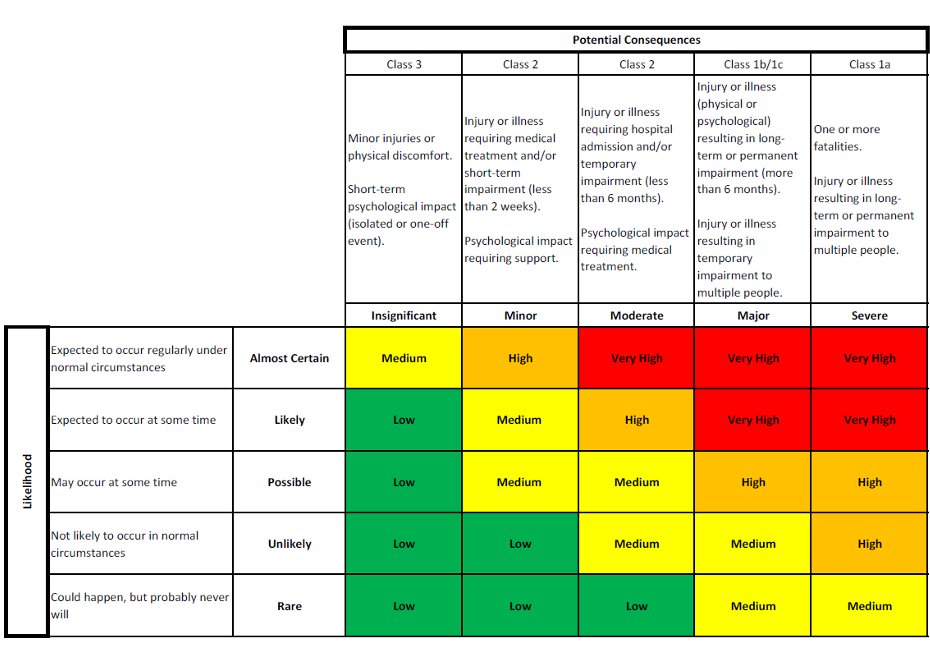
The risk matrix defines:
- Likelihood levels: Rare, Unlikely, Possible, Likely, Almost Certain
- Consequence levels: Insignificant, Minor, Moderate, Major, Severe
- Risk ratings: Low, Medium, High, Very High
End of Risk Assessment
Related Documents
- Safe Work Procedure - Detailed operating procedures
Document Control
| Version | Date | Author | Changes |
|---|---|---|---|
| 2.0 | 2016-06-16 | Chris Betters | Initial release |